Ok! Time for a more positive post this week!
When I tell people that I am studying to become a Health and Social Studies teacher, they often do not see the connection between the two at first. I’ll admit that I didn’t either. I thought I’d be teaching two fairly unrelated content areas and that most administrations would view it this way as well. But the more I delve into the “whys” of both subjects, the “hows” of how they are connected and related surface almost entirely on their own.
Photo by Aleks Magnusson on Pexels.com
Social studies are the study of how humans interact with each other and the systems they create to organize the world on both a massive and individual scale. Health Education teaches humans how to make informed decisions that could affect their own or others’ health. The collective health decisions of a population can influence how people interact and how the systems they create function. Health education asks students to reflect and become intimately familiar with the smallest human system – their own bodies and minds, which, ultimately, make up the larger systems they are a part of.
Health and Social Studies are incredibly intertwined when we think of them in this way. Here are just five ways that the two subjects intersect.
1. Health behaviors are a study in cultural norms and values.
The health behaviors that populations engage in can tell us a plethora of information about the culture in which the population lives. They can tell us what resources a population has access to. The types of health resources I have access to as an American living in Portland, Oregon vary greatly from the resources that my brother’s coworkers have in Kampala, Uganda. How does access to these resources influence my health behaviors in different or similar ways to a Ugandan woman my age?
The cultural values of a population can influence how people view a health behavior and influence whether or not a person will engage in it. An industrialized nation like the U.S.A where the citizens have little leisure time and that places a high value on consumerism sees high levels of sedentary lifestyles and therefore high levels of obesity and cardiovascular disease. Obesity is less rampant in European countries where work-life balance is highly valued and consumerism and processed, “insta-foods” are devalued.
2. Health advocacy education is civic education.
In the U.S. and Oregon health education standards, high school students are expected to demonstrate their ability to advocate for personal, family, and community health. Advocating for behaviors and/or policies that affect the self and others is an exercise in civic duty. Teaching students how to voice their concerns to those in power is a vital piece of keeping democracy alive and well. Learning about how health-related policies are created and enacted is a lesson in how our government works and how it affects our everyday lives.
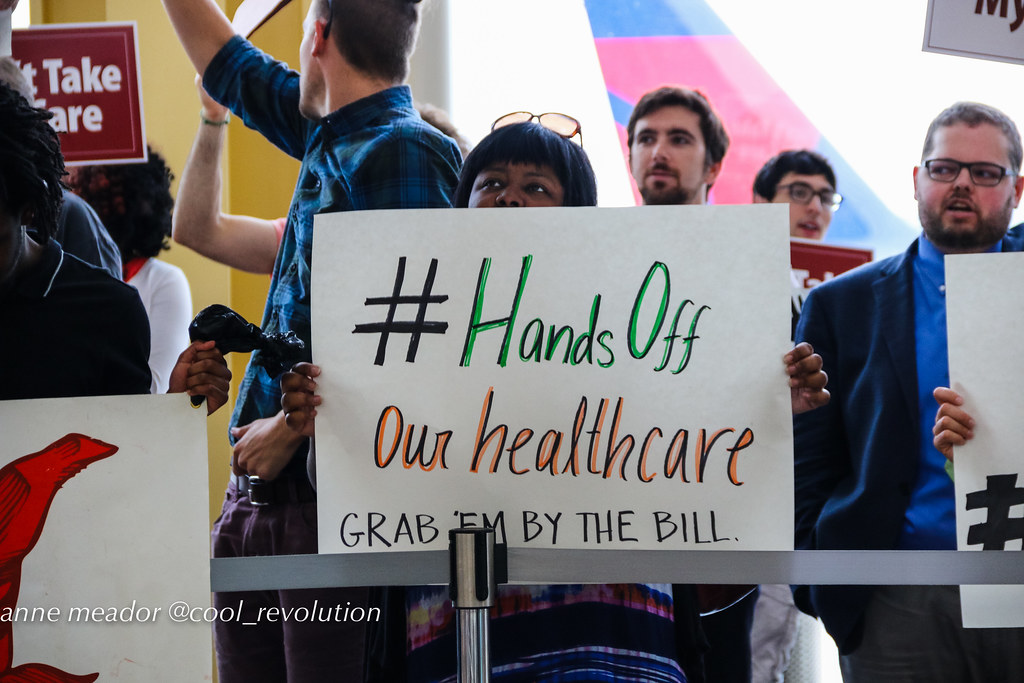
“Hands Off Our Healthcare” by cool revolution is licensed under CC BY-NC-ND 2.0
3. Health issues have often been part of or a direct catalyst for massive social change.
Health issues are personal. The personal has always been political. The LGBTQ rights movement was propelled forward in the 1980s as a direct result of the immense activism that sprang from the HIV epidemic. The long-sought after medical solution to family planning led to the invention of the birth control pill in the 1960s. The women’s movement would be nowhere near where it is today without that medical advancement. It changed family planning and, therefore, gender roles and the social mobility of women across the world. Prohibition in the 1920s and 1930s was fueled by the Temperance Movement, which advocated for the prohibition of alcohol on the grounds of the domestic violence it contributed to in millions of families.

“square the circle1” by spentpenny is licensed under CC BY-NC-ND 2.0
4. The health of a nation or population affects human systems.
Disease has played a major role in shaping human history and effecting human systems – we often overlook it because disease is not a human agent. But it has an enormous amount of control over the events on Earth. The Bubonic Plague is a great example of the effects that health issues can have on every facet of life. The Plague killed a third of Europe’s population in less than a decade the first time it struck. Populations lost a massive amount of their workforce (perhaps this was good for those who survived who could demand higher prices for their services), governments closed ports and entire cities in efforts to contain the disease, the population loss resulted in a smaller population using fewer resources and contributing less to society. The death of entire populations of Native Americans in North America was a result of disease brought from European settlers. It’s easy to argue the profound effect this had on Native history and American history. Disease education and prevention in a classroom is the first step to preventing an epidemic. Education and behavior modification was the first line of defense during the HIV epidemic before medications were discovered to curb the spread of disease.
5. Current events analysis, value development, and source analysis are cross-over skills in both subjects.
Part of any good health and social studies curriculum includes analyzing current events, helping students develop opinions of their own, and determining factual sources from fictional information. Because health is an ever-evolving field that affects everyone, it’s always in the news. Healthcare reform, health disparities, violence prevention, mental health concerns, the opioid crisis are all health issues that are being discussed civically. Engaging in debate about these issues help students develop the skills to defend a position and justify their argument. This vital skill is helpful for both engaging in democracy, promoting diverse thinking, and personal conflict resolution. It is through debate and discussion that students develop their own values. Value development allows students to be thoughtful citizens and helps guide them in health decision making. Learning how to evaluate a source for accuracy is a skill that is hard hit in social studies but is also used in health classes to evaluate whether a piece of health information is trustworthy.
I’d love to hear other people’s thoughts on additional ways Health Education and Social Studies collide! Thanks for reading!
 Amateur Hour